
The Dq Life Blog
Go back
Why Other People’s Stress Becomes Your Stress: The Science of Contagious Stress
Other people’s stress becomes yours. Not metaphorically — neurologically. Here is the science behind why, and what to do about it.
You walk into a room and something shifts. Nobody has said anything yet. But you feel it. Within moments you are tense, guarded, your thoughts beginning to scatter. The stress in that room was not yours when you walked in. It is yours now.
This is contagious stress, and it is not a metaphor. It is a neurobiological process, and understanding it changes the way we think about our own wellbeing entirely.
We are wired to catch each other’s stress
Our brains are, first and foremost, social organs. As Bessel van der Kolk observes in The Body Keeps the Score, “our brains are built to help us function as members of the tribe… most of our energy is devoted to connecting with others”. From our earliest relationships throughout our lives, our encounters with others constantly shape and direct our inner experience.
“Our brains are built to help us function as members of the tribe…Most of our energy is devoted to connecting with others.”
Bessel van der Kolk, The Body Keeps the Score.
Central to this is what neuroscientists call our resonance circuitry: a network of mirror neurons and neural systems that align our internal states with those of the people around us. When someone nearby is stressed, these circuits do not simply register that as information within our brain. They replicate it across our body. Their stress hormones, adrenaline and cortisol, begin to flood our own system as though we were facing the original threat ourselves (Auer et al., 2024).
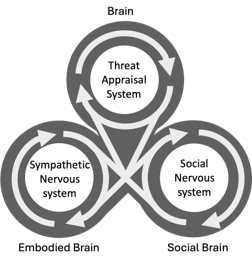
This process operates largely beneath conscious awareness. We do not need obvious signals to know that something is wrong. Through what Stephen Porges terms neuroception, our nervous system detects threat in the environment before conscious thought has even begun. A fractional shift in eye contact. A barely perceptible change in vocal tone. Research by Mujica-Parodi and colleagues demonstrated that people even detect fear through the chemosensory signals in the sweat of others. A stress response is triggered within us, with no conscious awareness of having received a signal at all. We know, before we know, that we know.
“Special attention goes to defining the details of a system of minor-appearing stimuli that trigger intense emotional responses in the other… [they] operate more out of awareness than in awareness. There are hundreds and perhaps thousands of these stimuli in any intense emotional interdependence”
Murray Bowen, Family Therapy in Clinical Practice
Why we evolved this way
From an evolutionary perspective, this sensitivity was never a flaw. Human survival was always a collective discipline. When one member of the group detected danger, the whole group needed to feel it fast. The almost instantaneous contagion of fear across a group meant collective escape was possible before deliberate thought had begun. One person spots the predator; the whole tribe is already moving.
The problem is that this system has not updated to reflect the world we now inhabit.
The liability of an ancient system
But an ancient system built for one kind of threat struggles with another. Most of what we face nowadays is not life-or-death, where immediate collective action solves the problem. It is complex and ongoing: a friend’s difficult diagnosis, a spouse’s struggling business, a child finding their way through exams. Here, is no single decisive group action that ends the threat, and this is precisely where catching other people’s stress stops being useful and starts being a hindrance.
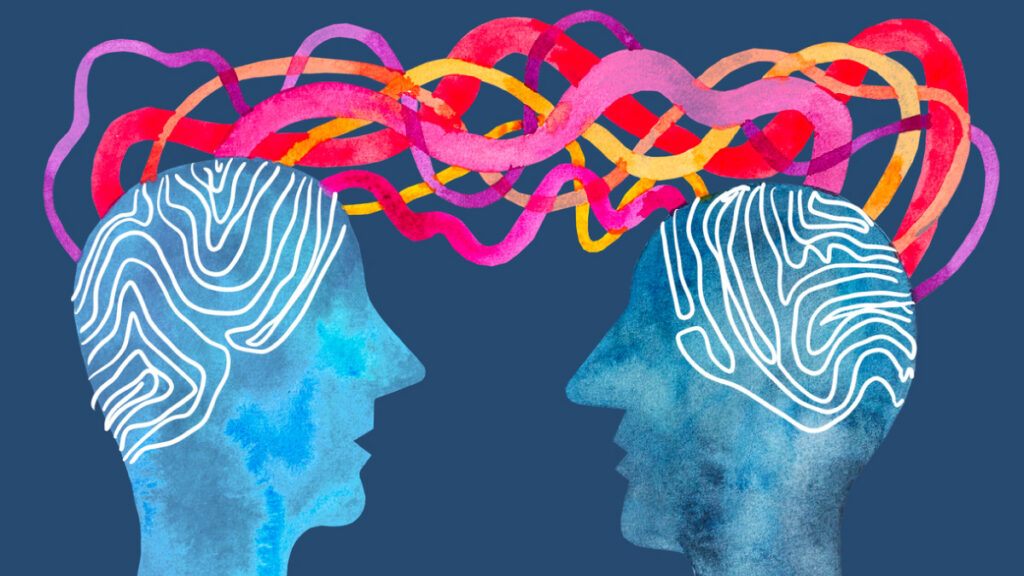
When we absorb someone else’s adrenaline, our capacity to think clearly and calmly is lost. We cannot sit quietly and listen, because the urge to jump into action, any action, becomes compulsive. We lose the ability to hold nuance and complexity, defaulting instead to simplistic, black-and-white solutions. The very mechanism built to help a group move fast in an emergency makes us worse at solving the slow, multi-layered problems most of us are actually navigating.
This impairment in thinking is only half the cost. The stress absorbed this way is also uniquely difficult to process. When we face a direct threat, we can engage with it, act on it, discharge the tension it generates. But stress absorbed from someone else sits differently. We cannot name it because it did not originate in us. We cannot address it directly because the source lies outside our control. It accumulates within us as chronic, background tension: harder to locate than acute stress, and for that reason, harder to shift.
This is why high-functioning, conscientious people so often find themselves burnt out by circumstances that look, from the outside, entirely manageable. The problem is not their resilience. It is the invisible load of stress they have been absorbing, without knowing it, from the systems around them.
Bowen Systems thinking offers a framework for understanding exactly this: how stress moves between people, and how we can begin to interrupt it. A good place to start is discovering your own stress contagion profile with the Stress Contagion Quiz.
References
Auer, A., Walther, L.-M., Jendryczko, D., Auer, L., & Wirtz, P. H. (2024). Is your stress my stress? A standardized, randomized-controlled paradigm to study physiological stress contagion based on direct stress observation. Psychoneuroendocrinology, 162
Bowen, M. (1978). Family therapy in clinical practice. Northvale, NJ: Jason Aronson.
Mujica-Parodi, L. R., Strey, H. H., Frederick, B., Savoy, R., Cox, D., Botanov, Y., Tolias, A., Cucciniello, D., & Tolias, J. (2009). Chemosensory cues to conspecific emotional stress activate amygdala in humans. PLoS ONE, 4(7)
Porges, S.W. (2011). The Polyvagal Theory: Neurophysiological Foundations of Emotions, Attachment, Communication, and Self-Regulation. W.W. Norton.
van der Kolk, B. (2014). The Body Keeps the Score: Brain, Mind, and Body in the Healing of Trauma. Viking.